
October 7, 2026
Why Sim Racing?
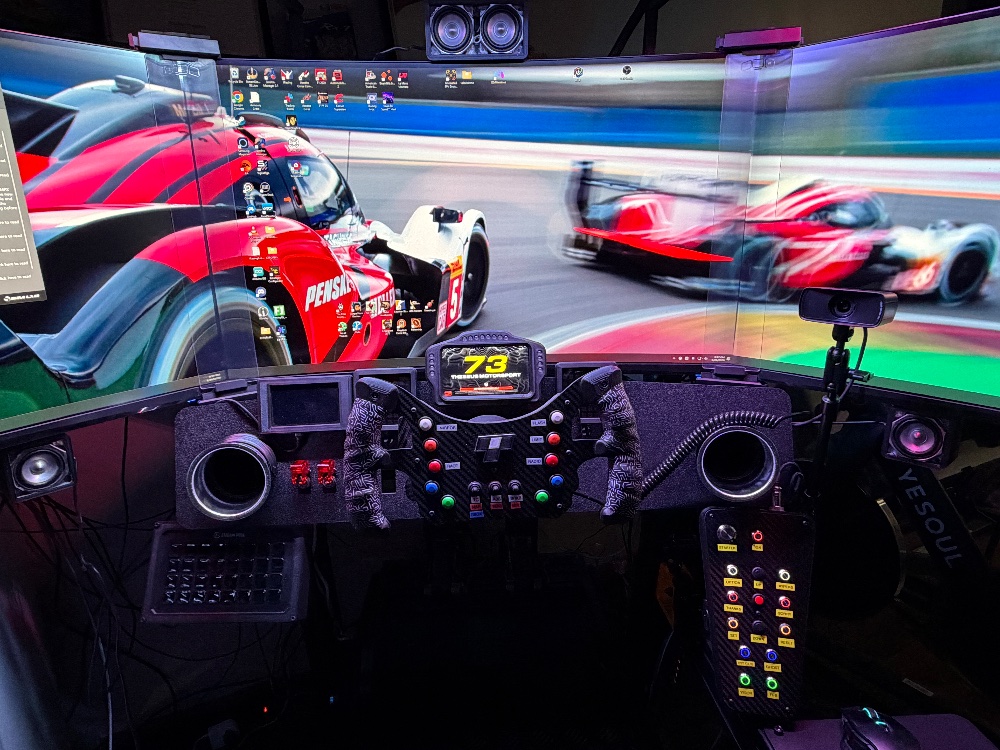
I’ve always loved cars. But aside from my personal cars over the years, I’ve always been a passive observer of real sports cars. I’d go to the car shows and imagine what it would be like to drive one or, at best, own one. In the rare instance someone would invite you to sit in something like a Ferrari or Porsche. In my case, for the car shows I went to, it was less Ferrari and more Fiero. And then you grow up, and it doesn’t happen so much because you’re in your 30s and already had time to appreciate cars.
Because I grew up loving cars, naturally I got into video games that featured cars. I can successfully brag that I’ve owned every version of Gran Turismo starting with the PS1 and played them until their figurative wheels fell off. My first experience with a race wheel for a video game, outside of my uncle’s real-life Cruisin’ USA arcade machine in his basement, was a basic Mad Catz wheel and pedals plugged into a Nintendo 64 to play Beetle Adventure Racing and Automobili Lamborghini. I was awful at it, but I guess that’s what you get trying to balance the wheel mount on your lap while simultaneously maneuvering the pedals on carpet without them sliding around.
Finally, a couple of years ago, I saw a sale on one of the Logitech belt-driven wheels. I decided to buy it and match it up with my Oculus Rift VR headset to see if I could finally get into sim racing and see what it was all about. It was a big letdown. The steering felt notchy and loud, and while there was some return to center, it didn’t really feel like there was much resistance. I ended up selling it and decided it wasn’t for me.
That’s when I discovered the difference between direct drive and belt drive. I took another chance on a Fanatec CSL DD sale and gathered some wood, a fiberglass seat, and an old TV and built a starter sim rig. The wood was basically 6x4 pieces cut and screwed together in a familiar cockpit form that I’d seen online. The ergonomics probably weren’t correct (they weren’t, as my arms and back later learned), but it was something. I made a special tray for my gaming computer at the time, a Lenovo laptop. It was just enough power to run iRacing on my 40” screen. The wheelbase was only 5 Newton-meters (Nm) of strength, but it was already far better than what I imagined it would be. I finally got the hype. Adding in the ability to play against other live players only made it an even more engaging pastime.
The rig has vastly improved since then as far as features and immersion. Part of the enjoyment is making it as close to a real car as possible, and there are so many ways to do that. So when the question of “Why Sim Racing?” comes up, or people want to know more about it, it really comes down to a combination of things.
First, the love of all things cars and the chance to feel like you’re actually driving the real car. The interior visuals, especially on a triple-screen setup or if you’re dedicated, an ambient lighting kit, along with the audio of the engine and tires in a 5.1 configuration. While it’s not the real experience, it’s as close as you’re going to get in your living room on a Monday after a long day at work.
Second, there is the personal goal of self improvement. Every lap is a new chance to improve or fail to improve, but always learn something in the process. Slowly finding new ways to cut off one tenth of a second or sometimes almost a full second, all while trying to deal with tires that will heat up if you push it too hard. I think that the methods used for improving lap times often carries over into your life outside of the sim rig. Every day is a new challenge and finding something to improve in small ways can make a big difference.